For plot-related reasons, I needed Wickham to be more competent than the short-sighted grifter who wreaked so much havoc in the original novel. Even so, he ends up working too many angles at once and having things blow up in his face. I can’t tell you more than that without spoilers.
When I first came up with the idea for Pride & Planetoids, I decided that Elizabeth Bennet needed to be some kind of Parliamentary backbencher. Spending time in the remote work/zoom conference culture of the early 2020s made it more believable to me that she could live at Longbourn and still participate in the Parliament of Albion the Commonwealth, without having to travel to Albion, the asteroid which gave its name to the Commonwealth. There were a whole horde of supporting characters who were also believable as minor politicians in a large Parliament, which meant that Mr. Collins, Mr. Hurst, etc were all accounted for. I still had to figure out where the Bennet family sat in this society, and that meant figuring out the society itself.
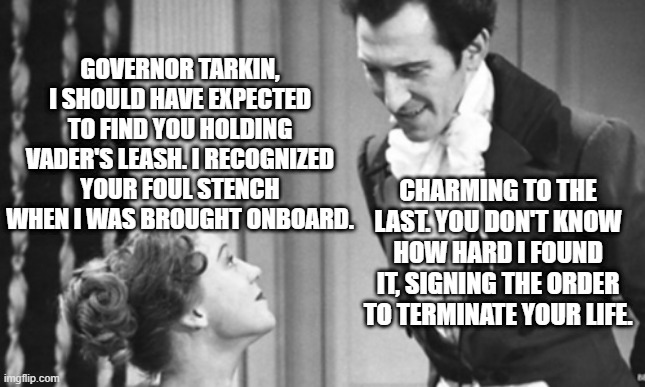
(Thank you, unknown internet person, for creating this meme. It makes the job of explaining the origins of my latest novel so much easier.)
Well, let’s start with the fact that I am a GenXer, who grew up with a limited selection of movies available to me, and more often than not the only thing my siblings and I all felt like watching was the 1977 Star Wars. For some reason, I was very amused to discover that Grand Moff Tarkin had once been an energetic middle-aged man who killed the Hound of the Baskervilles twice and Count Dracula over and over again. It tickled me even more to discover that he had once played Mr. Darcy in a now-lost BBC adaptation of Pride and Prejudice, roughly a quarter of a century before Star Wars. I asked myself: “What if Darcy went around destroying planets?” And a surprising amount of Pride & Planetoids grew out of that single question.
So, having gotten Pride & Planetoids revised, formatted, and up for preorder, I thought I’d share a few thoughts on the use of AI in the revision process, both the automations (see here for the original post on this topic) and the chatbot(s).
Religion is not at the foreground of the stories I tend to tell, but it is in the background, part of the “vibe,” so to speak. I tend to stick to versions of a specific cosmogony (Creator+quasi angels+quasi devils), partly because it reflects my own Catholic beliefs, but also frankly because my world-building energy is limited, and most of the time, I’d rather spend it elsewhere.
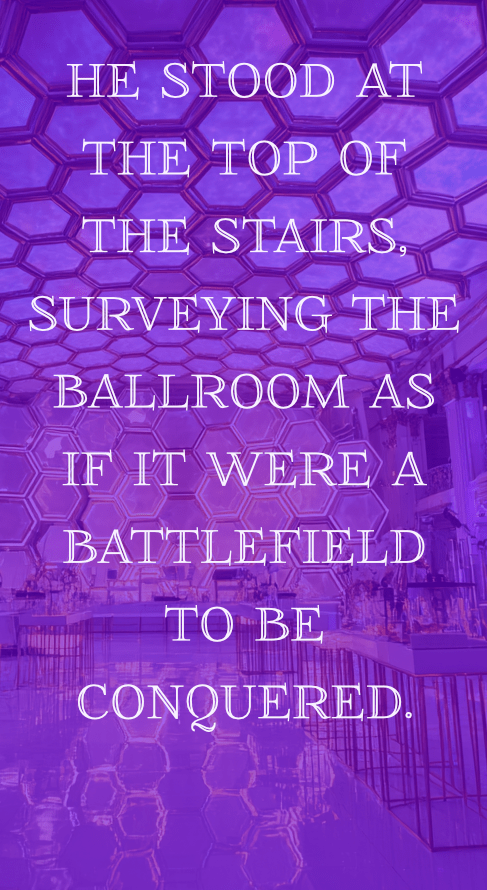
Longbourn’s ballroom was the site of most of the asteroid’s streaming videos, and Mrs. Bennet had insisted on giving it a more regular shape than most of Longbourne’s interior spaces. The space was an immense rectangle with gleaming white marble floors and columns that reflected the purple and gold lights. The far wall was decorated with a pattern of hexagonal screens set in gold frames, which continued across the ceiling. The main video feeds played out on the screens on the far wall, the more minor ones being relegated to a merely decorative role on the ceiling.