
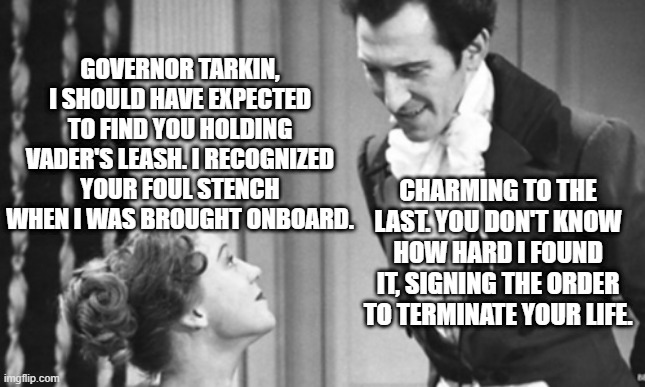
(Thank you, unknown internet person, for creating this meme. It makes the job of explaining the origins of my latest novel so much easier.)
Well, let’s start with the fact that I am a GenXer, who grew up with a limited selection of movies available to me, and more often than not the only thing my siblings and I all felt like watching was the 1977 Star Wars. For some reason, I was very amused to discover that Grand Moff Tarkin had once been an energetic middle-aged man who killed the Hound of the Baskervilles twice and Count Dracula over and over again. It tickled me even more to discover that he had once played Mr. Darcy in a now-lost BBC adaptation of Pride and Prejudice, roughly a quarter of a century before Star Wars. I asked myself: “What if Darcy went around destroying planets?” And a surprising amount of Pride & Planetoids grew out of that single question.
First of all, Mr. Darcy, unlike the Moffster, would not blow up celestial bodies without justification. They would have to be uninhabited celestial bodies that were somehow a threat to inhabited celestial bodies. The Flora asteroid family, which is a fairly dense set of asteroids prone to collision events, was my initial role model. After going down a few rabbit holes, I decided to move the action out to the Kuiper Belt instead, and stage an initial collision event (millions of years ago) between two different types of celestial bodies. This would give the humans living there as wide a variety of resources as possible. And so the Hector-Sabrina family of asteroids was born. I decided Darcy’s warship ought to be spherical, and the easiest way to arrange that was to make it a converted asteroid. Most of the other warships in the same class are more elongated and potato-shaped.
Of course it goes without saying that the culture which produced Mr. Darcy, Destroyer of Worlds, would be some kind of futuristic ersatz-Regency, like the ersatz-Roman Empire in R. M. Meluch’s Tour of the Merrimack series or the very ersatz-Middle Ages in The Warlock In Spite of Himself by Christopher Stasheff. I threw in the idea that Darcy’s culture was paying back Earth’s investments in them with endless social media streams. It seemed like the kind of thing that would motivate people to maintain their “theme-park version” of a specific historical moment for several generations. It occurred to me that machinery powered by the successors to the large learning models (LLMs) of today would probably end up doing a lot of the work handled by human servants in the actual Regency, so that went into the setting as well.
Obviously, the Space Regency people needed some kind of external enemy within the asteroid family, willing to throw rocks around and thereby keep Mr. Darcy in business. The obvious answer was Space French people, which didn’t work for me. Instead, I invented Helles as a culture which spun off from the Space Regency after deciding it was more interested in the civilizations that influenced the Regency than in the Regency itself. Basically, they wanted to be Space Greeks rather than Space Georgians.
I didn’t want Darcy to be a Captain Darcy or a Commander Darcy (or a Grand Moff Fitzwilhuff Darcy), just Mr. Darcy. So I made him a privateer, and decided that Terra was very jealous about anything resembling a Navy among its colonies. This turned out to be important to the plot later. Elizabeth needed to see him at work early on, and making her a Parliamentary backbencher was the easiest way to arrange that. I wanted something similar to the Pemberley reveal, showing a kinder, gentler Darcy and a less military side to his dreaded superweapon, so his warship turned out to have been originally designed as a generation ship to ferry people (and Terrestrial ecosystems) to other worlds. Darcy, destroyer of worlds, proved to also be a man who grows apple trees with robins in them. This in turn meant that there was someplace the Space Regency people were supposed to be going, rather than just hanging around the Kuiper Belt indefinitely. That gave me some more pieces of plot, plus an angle for the sequels.
By this point, as you may have gathered, the setting was not remotely “a long time ago in a galaxy far, far away.” More like “somewhere in our solar system, a hundred plus years into our future.” But the naming convention of the marcher-ships was one last detail that I owed to Star Wars. The actor behind Tarkin once joked that if he had named the battle station in the movie, he would have used a tombstone epitaph, like Monrepos (Mon Repos/My Repose) or Dunroamin (Done Roaming). So Darcy’s ship became the Last Repose, another of its class became the End-of-Line (“Done Roaming” by way of Tron), and eventually other marcher-ships gained equally genteel and ominous names like the Blue Ruin and the Pallbearer.
You can extrapolate an awful lot from a silly question like: “What if Mr. Darcy went around blowing up planets?”
 Jaglion Press
Christopher Stasheff! Now there’s a name I haven’t heard for a long time…a very long time…
LikeLiked by 1 person
😀 I’m glad someone remembers him besides me. The Obi Wan reference is also appreciated.
LikeLiked by 1 person