
The Albion Courier, Features Desk
[During our video conference with Elizabeth Bennet, Member of the House of Resources for Longbourn Mining Company, she offered to show us around. What follows is an edited account of that tour, with images drawn from Longbourn’s public broadcast archive.]
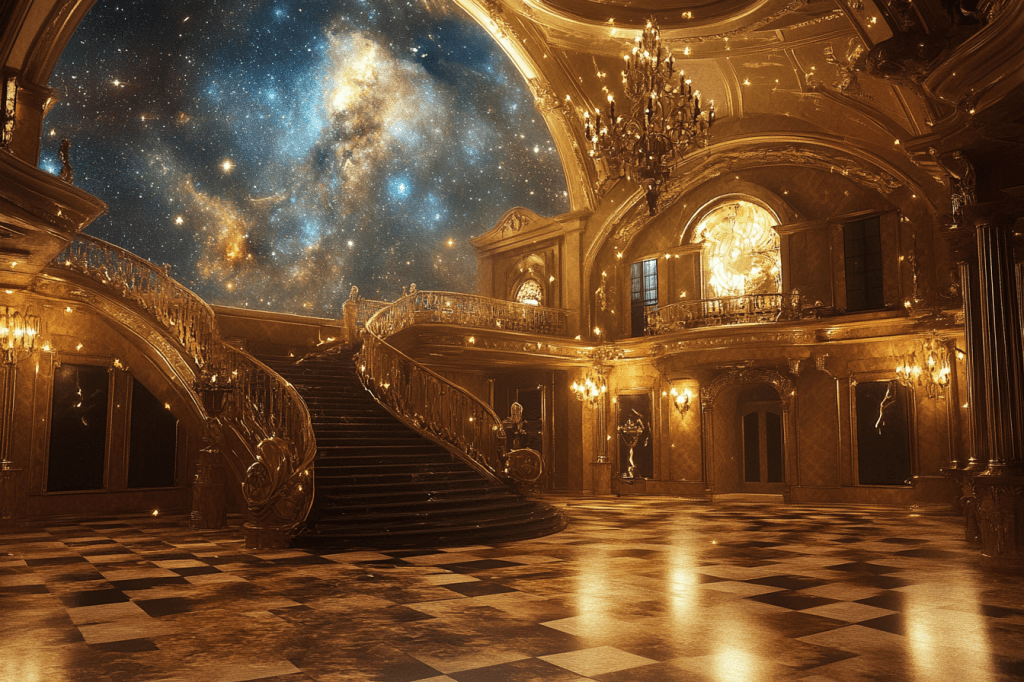
The first thing you see when Elizabeth Bennet turns the camera toward Longbourn’s Great Hall is the mural above the staircase, except it is not a mural, but a curved screen showing a color enhanced view of deep space, relayed from a telescope on the asteroid’s surface. The effect, at the scale of a room that could comfortably hold a hundred people, is somewhere between sublime and vertiginous. The stars move too slowly to perceive.
The grand staircase sweeps upward in twin curves of gilded ironwork, rising to a mezzanine level from which doors lead to Longbourn’s upper residential and entertaining spaces. The chequered floor below it is dark stone, worn smooth by six generations of foot traffic, and reflects the starfield above with the fidelity of still water. It is, by any measure, a remarkable room.
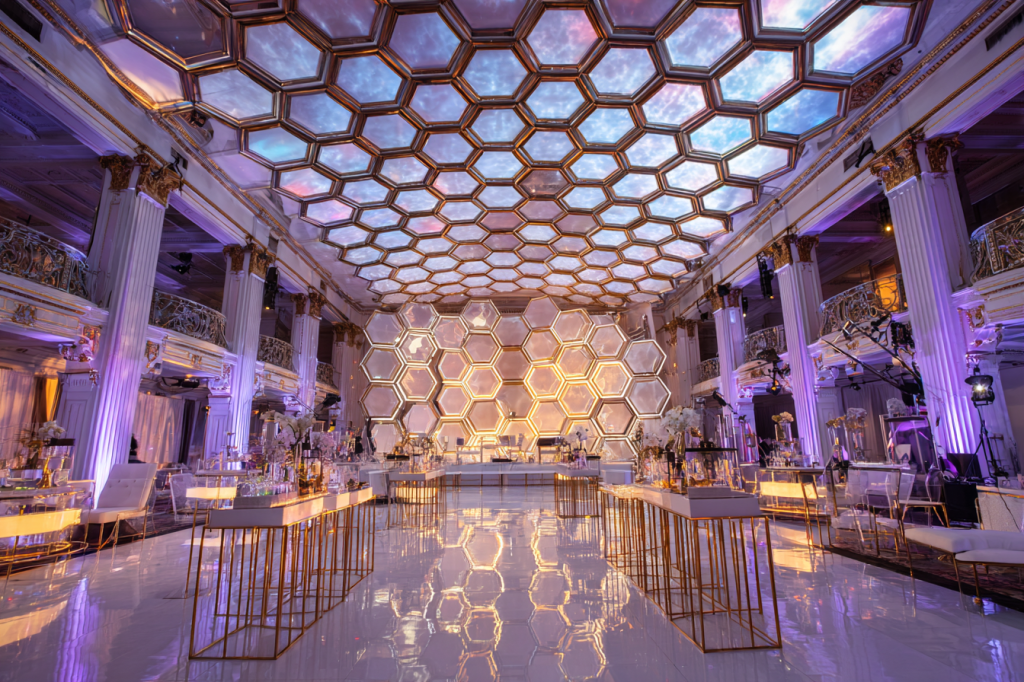
The ballroom is reached from the mezzanine level, through a set of doors that Elizabeth opens with the confidence of someone who has done it ten thousand times.
Mrs. Bennet’s influence on Longbourn’s interiors is a matter of public record, and the ballroom is its fullest expression. The ceiling is a honeycomb grid of hexagonal screens designed to show feeds from all the cameras present at a ball. The effect is simultaneously otherworldly and, Mrs. Bennet would insist, very much of the moment. The walls are white and gold. The dance floor is white marble, and reflects the ceiling back at itself with mirror precision.
“It holds four hundred comfortably,” Elizabeth says. “My mother considers this a constraint.”
She says this pleasantly. She moves on before the journalist can ask a follow-up.
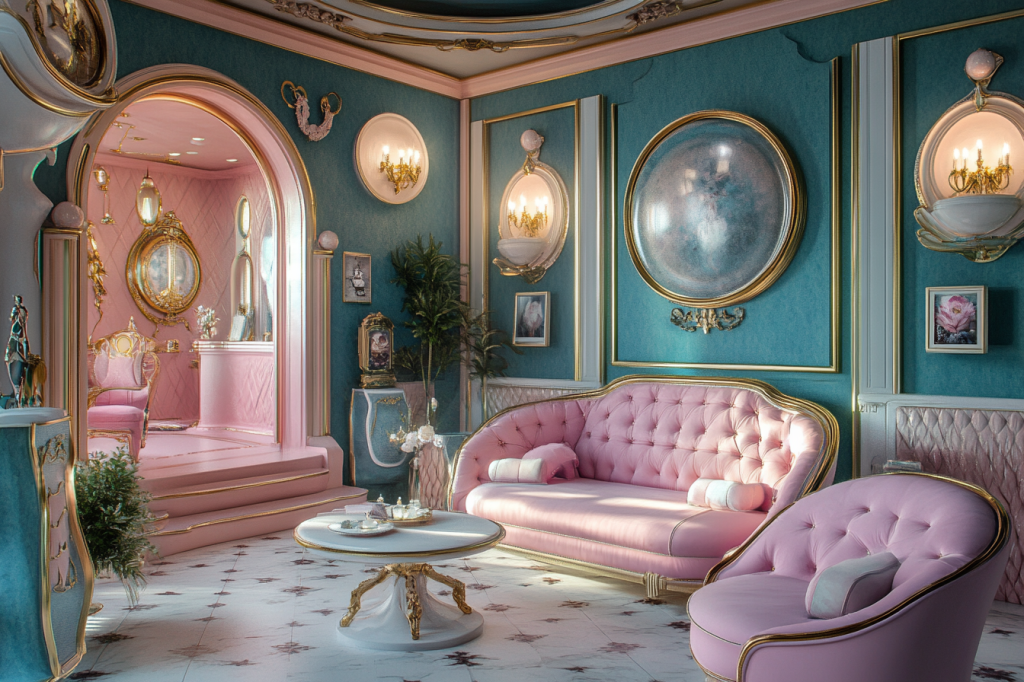
The family parlor is smaller and considerably more personal than the public rooms, which is perhaps why Elizabeth lingers here longest in the tour.
The palette is Mrs. Bennet’s: rose pink and deep turquoise, gold detailing on every surface that will accept it, an arrangement of curved sofas that prioritizes comfort over formality in a way the Great Hall does not. The round mirrors on the walls are a recurring motif throughout Longbourn’s private spaces, a practical concession to an asteroid interior where no window can look outward at anything except rock, and where the illusion of depth and light must be manufactured by other means.
There are photographs on the walls: family portraits, images of the asteroid’s exterior, a few that appear to be landscapes from Terra that Elizabeth does not comment on and the journalist does not ask about. A small plant on the side table is real, not simulated, which in the interior of a mining asteroid is its own quiet statement of priority.
“This is where we actually spend most of our time,” Elizabeth says. “The Great Hall is for company.”
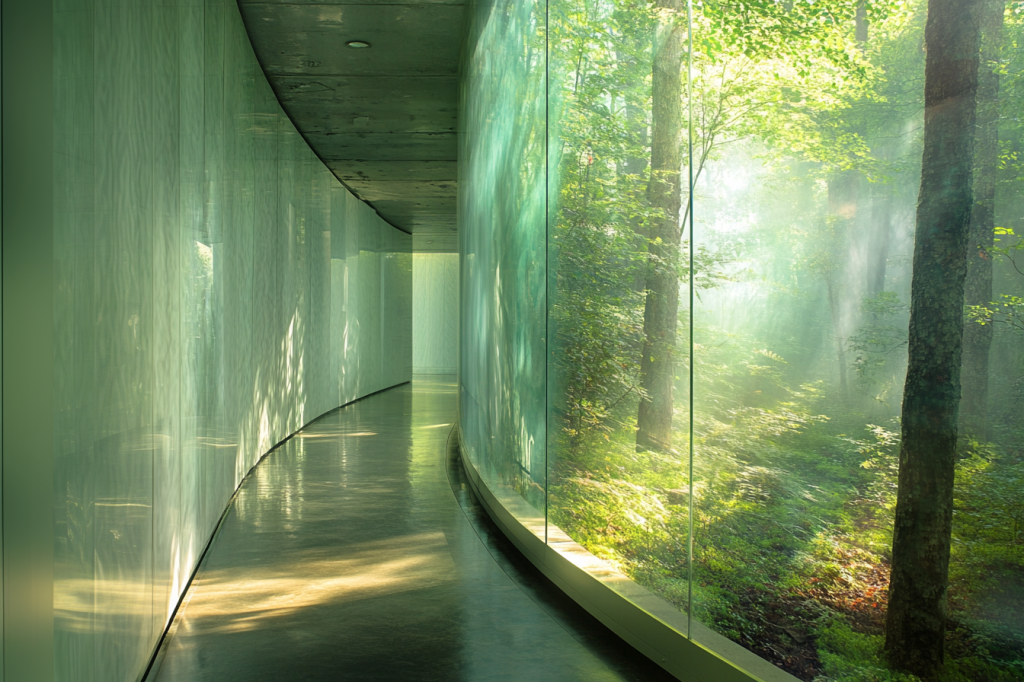
The tour ends, as the best tours do, somewhere unexpected.
The path to Longbourn’s greenspace runs along a curved glass corridor. One side opens into the business offices of Longbourn and the greenspace itself is visible through the glass on the other. The effect is of walking along the edge of a forest that exists inside a mountain: trees pressing against the transparency, light filtering through canopy that has never known a sun, the air already different here, green and alive in a way that the rest of Longbourn, however beautiful, is not. She lets the camera-drone look toward the glass for a moment longer than strictly necessary. Through its microphone, we can hear the gurgle of a fountain, somewhere in the greenspace. Then she orders the drone back toward the corridor, and the tour is over.
→ Read our profile of Elizabeth Bennet, Member for Longbourn
Pride & Planetoids is a space opera retelling of Pride and Prejudice, set among the asteroid families of the outer solar system. Longbourn Mining Company, and the family that runs it, are central to the story.
 Jaglion Press