NaNoWriMo Toolkit: Write Or Die

A few years back, I discovered a unique writing productivity app called “Write Or Die.” Basically, you would set a timer and a wordcount goal, and type in a browser window. If you stopped typing, the screen would gradually turn red and then the app would start playing annoying sounds.

Write Or Die is not especially your friend when you genuinely have no clue what to write next. For that you are better off turning to this technique of author Rachel Aaron’s, where she sits down and tries to figure out what exactly is going on in the next bit she needs to be writing.

Where Write Or Die shines is overcoming that inertia when you know you need to be writing, you know more or less what you need to be writing,  but you just can’t seem to pull the trigger. Give it a try sometime, and see if it works for you.

NaNoWriMo Toolkit: Sleep

A very underrated tool in the NanoWriMo toolkit is sleep. If your body does not get enough sleep, your brain will not be able to focus on what you’re writing. You will become grumpy and annoyed with your project. In other words, a lack of sleep is an open invitation to writer’s block. This is usually the point where the blogger starts talking about all-night writing sessions fueled by coffee, tea or the caffeinated beverages of their choice.

I don’t drink caffeine anymore. A couple of years back, I notice that I had trouble focusing on what I was writing during NanoWriMo when I drank even a single can of caffeinated soda. So I stopped drinking it, and since I didn’t like the taste of coffee or tea, I didn’t drink either of those instead. I’m not going to say that you shouldn’t drink caffeine, because I know it works for some people, and it is definitely too close to NanoWriMo to try quitting caffeine, because it’s no fun to trying to write with the “caffeine withdrawal” headache. But please try to remember that it is no substitute for a good night’s sleep.

NaNoWriMo Toolkit: Protection Against Repetitive Stress Injury

The most important tool in your toolkit for NaNoWriMo are your arms, wrists and fingers.  From about now through the start of November, you should be resting them whenever possible.  Of course, you may have a day job just as I do, where there is no way to avoid using a mouse and keyboard.  But you can stop playing games on your phone computer or gaming system, avoid unnecessary typing on social media, and adopt the best posture possible.  This website has the most complete information I had found on avoiding repetitive stress injury by adopting the right posture, and trying to recover from it once you develop it.

During NaNoWriMo itself, remember to take frequent breaks from the computer to relieve wrist pain, and eyestrain.  Ice packs are also helpful, hot packs are less so, because they cause the joints to swell even more while the cold packs reduce the swelling.  If you sleep on your side, it is best to not sleep on your dominant hand.  You can also try dictating text, as I’m doing right now.  The first time I tried Microsoft Office speech functions was around 2006 or 2007.  It was practically unusable back then.  This version almost seems workable.  I hope to dictate at least part of my NaNoWriMo project this year.  I guess we’ll see how this experiment goes.

NaNoWriMo: Music to Write Books To

I’ve talked a little bit about music as a productivity tool, particularly in regard to outlining.  Today I would like to talk about music to write books to.  I personally have trouble listening to music with lyrics when I am writing.  I just start thinking about the singer’s words instead of my own.  For this reason, I tend to favor movie soundtracks or video game soundtracks.

Modern movie soundtracks tend to have many sedate passages with no clear melody or rhythm so there are usually only one or two tracks that work with my writing play lists.  What I had found works the best when it comes to movie music, tends to be soundtracks written between 1965 and 1990.  There is usually a main theme catchy and memorable, repeated in several different variations across the soundtrack.  There may also be a memorable villain theme or a sweet love theme, which may appear several times.

I usually did not give enough face time to my villains for them to rate their own play list of villain themes, but sometimes a play list of love themes comes in handy.  Most of the time, I turn to a game soundtrack that is driven and adventurous, repetitive enough and catchy enough to keep the fingers galloping over the keyboard, sinister enough to include the villain, romantic enough for the love story.  This soundtrack is Castlevania: Curse of Darkness, by Michiru Yamane.

I like her soundtracks to Castlevania: Symphony of the Night and Castlevania: Lament of Innocence even more as music than I do Curse of Darkness, but for me they’re too closely associated with my memories of playing the games when I was younger.  For some reason I never got around to Curse of Darkness, so the tunes are still fresh for me, and I can associate them with whatever I’m writing.  I particularly like these tracks: Baljhet Mountains, Garibaldi Courtyard, Garibaldi Temple, Mortavia Aqueduct, Mortavia Fountain, the Forest of Jigramunt, the Cave of Jigramunt, and Cordova Town. Most of the rest is too sad, too silly, or too harsh and dissonant for my tastes.

NaNoWriMo Toolkit: Music To Outline Books By

A lot of people listen to music while they work, and I am one of them. I’ve seen all kinds of theories about what kind of music is good for what tasks, but all I know is what works for me. For mindless data entry, I prefer stirring, exciting music that grabs my attention and takes me away to another place, like Jerry Goldsmith’s soundtrack to The Wind and The Lion, or James Horner’s soundtrack to Krull. If it’s the soundtrack to a movie I know really well, like The Good, The Bad, and The Ugly, or the Indiana Jones movies, it doesn’t seem to work as well.

But there are tasks that I find stressful or intellectually challenging, that involve math or problem-solving. And then, there’s outlining my novels, which is a little bit of all four. (Less math than some things, but it does come up.)  For outlining novels, and for those other tasks, I have a secret weapon: Baroque Favorites by the Jacques Loussier Trio.

Jacques Loussier is a French-born jazz pianist who performs classical music, from the Baroque era to Debussy, in a “cool jazz” style. He’s the leader of the trio that bears his name; the exact lineup has varied over the years but always includes a percussionist and some kind of bass player. A lot of people swear by his take on Bach, which honestly doesn’t do that much for me. Other people like his Debussy; personally I feel that Debussy is already so abstract that “jazzing him up” doesn’t yield interesting results.

I think the reason his interpretation of Baroque music works so well for me is the nature of the source material and the way it interacts with the improvisational qualities of jazz. In the Baroque era, there was an emphasis on making music both emotionally pleasing and intellectually stimulating. Music was intended to command the listener’s attention, in a way that busy working people often do not have time for.

Loussier’s approach makes Baroque music simpler and more approachable in some ways than it was originally intended to be. He arguably makes it calmer as well: the style of jazz he aspires to is all about conservation of emotional energy, because getting excited about things is profoundly “uncool.” The result seems to be music that stimulates the mind without demanding its full attention, and also calms and focuses the mind at the same time. (That being said, do not listen to Loussier when you are tired. You will not get the full effect!)

So, that’s the kind of music I outline novels to. I also find it helpful when I’ve written myself into a corner and am trying to write myself out again. It’s not passionate enough to help me stay in the “zone” when I’m writing the fun parts, but that usually requires a different kind of music all together…and that is a post for another time.


The Shape of Things To Come

Now that you’ve “met” Marrying A Monster, maybe it’s time for me to share a little more about the rest of the Jaiya series.

The main Jaiya series is currently three books long, and is set in “present day” Jaiya, or at least a timeframe where the technology and social developments are similar to our present day. I have some ideas for short stories or novellas about these characters, and if I come up with any more 50K-length stories in this setting, that grab me, I will write them.

Marrying A Monster is of course the first book in the series. The second book is currently titled Waking the Dreamlost, which was my Summer 2017 writing project. Monster‘s hero, Vipin, has an older brother named Marish, who is the hero of Dreamlost. I will probably spend the rest of October revising Dreamlost, along with some time in November if I finish with NaNoWriMo2016 early, and however much time it takes after that. The hope is to have it ready to go by before December 15.

Loving A Deathseer is the third book in the series in internal chronology, but the first one written. (How that happened is a story for another time.) The heroine is a relative of Vipin’s and Marish’s. This one is going to need a lot more reworking than Dreamlost, so there isn’t a timeframe for release yet.

There is also a Jaiya prequel series in the works. At this point, the only thing written is last year’s NaNoWriMo project, a fantasy romance with a gladiator/MMA fighter angle set 200+ years before Marrying A Monster. I am currently outlining a book about Vipin’s parents, which I hope to do for NaNoWriMo this year.

I also have a very rough idea for a book about Vipin’s grandparents, which I will try to write in the first quarter of next year. And there’s an even sketchier concept for a steampunk-y paranormal romance set about 75 years after the gladiator romance, and about 150 yrs before Marrying A Monster. The steampunk romance and the gladiator romance would both deal with Vipin’s ancestors. The series would start releasing sometime in 2017, barring complications.


Marrying a Monster is now live!

An exciting moment for me here: the book I first wrote back in 2013 and spent several months preparing for submission, is now available for purchase at a mere $0.99 on Amazon, Nook, iBooks, Kobo, All Romance Ebooks and Inktera. I submitted it to several ebook vendors through Draft2Digital, so hopefully it will go live at Scribd, etc. in the next few days.

Ebook Cover Reveal for Marrying A Monster!

One of my hobbies while I was working on Marrying A Monster was trying to make my own cover art. This produced a bunch of dubious results and two or three that were decent but not appropriate to my genre.

Then I went looking through premades. There are a lot of very talented designers who make premades available at reasonable prices, but a couple of things made my search more difficult.

One, my books are not steamy. The thing to remember about the “bare torso” style of cover art is that the author (and/or publisher) is usually being very honest in advertising the contents of the book. It attracts people who like that kind of content, and tells people who don’t like it to keep on moving. If I gave Marrying A Monster that kind of cover, it would be false advertising, which is a good way to annoy your potential buyers.

Two, the setting is a fictional country called Jaiya, “in a world not quite like ours.” Jaiya has elements of several cultures, including a religion very loosely inspired by Christianity, but the climate, ethnic groups, and parts of the country’s history are inspired by India, Pakistan, and the other countries in that area.

There are several places where I describe people as having gold or bronze or tea-colored skin…which meant that any piece of cover art with blonde or red-haired, fair-skinned people was automatically a no-go. I also describe the characters as mostly wearing modern clothes and talking on cell phones, so the handful of “Exotic India” covers I ran across didn’t seem to fit either.

I eventually decided that since people in that part of the real world several different ethnicities, it was okay to look at artwork where the characters could maybe pass for Mediterranean or Middle Eastern, or where the  stock photos involved had been manipulated so thoroughly that trying to judge the character’s ethnicity seemed pointless.

Then I fell in love with a particular premade at Rocking Book Covers and contacted Adrijus, the designer who runs the site. He was happy to make the font changes I asked for, and just submitted the final version to me today.

Ladies and Gentlemen, I am very pleased to present to you, the cover art for Marrying A Monster!
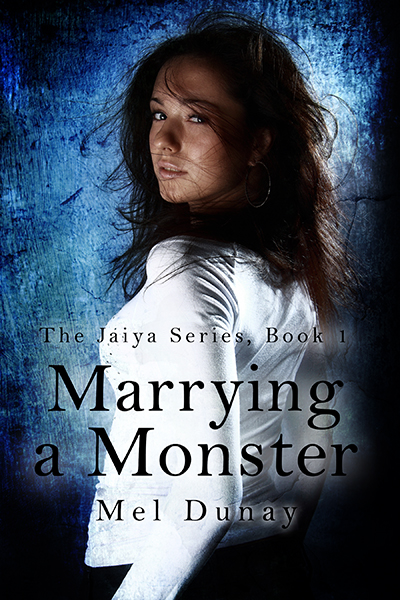
cheater-small

Title and blurb Reveal: Paranormal Romance Book 1

It is a world not quite like ours, where the insect-like Gnosha live alongside humans, cars, and cell phones; and stranger things lurk in the shadows. Rina is a city girl now, but she can’t bring herself to say no when asked to come back home for an old local custom: a symbolic marriage between her town’s young women and the Mountain King, a legendary guardian spirit. As Rina travels home with a handsome but mysterious folklorist, she learns that the Mountain King is real, and a monstrous menace….

Ladies and Gentlemen, I am very pleased to introduce to you the first book in my paranormal romance series: Marrying A Monster.

It’s around 50,000 words long, more sweet than sensual on the romance side, more eerie than gritty on the paranormal side. It takes place in another world, in a country called Jaiya. Jaiya is a place of seeming contradictions: with modern technology anyone of us would recognize, ancient traditions that speak of guardian spirits and Old Ones, and humans who may just have a trace of the Old Ones’ powers.

Rina embodies those contradictions in her own way. She considers herself a thoroughly modern woman who runs a clothing shop in Rivertown, Jaiya’s capital, but she goes home to take part in what is to her a meaningless ritual, so that her parents won’t feel embarrassed in front of their neighbors.

The dashing anthropologist Vipin carries his own contradictions within him. His good looks and gentleness draw Rina to him, but he may yet prove more dangerous than the Mountain King himself…