I don’t know how I managed to not set that up when it was on pre-order but it’s fixed now. Sorry about that.
Category: Uncategorized
On this May the Fourth, Spot the References in Pride & Planetoids
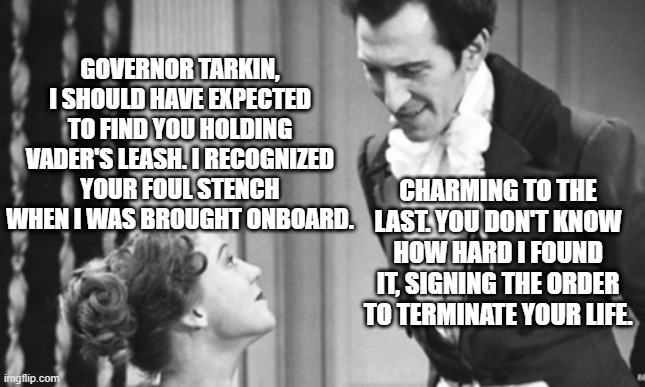
I’ve previously told the story of how one man’s peculiar career choices led to me asking the question: “What if Darcy went around destroying planets?” and writing a whole book about the answer. But somewhere along the way, I realized that this gentleman was not the only actor to jump from Jane Austen to Star Wars (or vice versa) in a professional capacity. Reader, I set out to include nods to them all. This proved to be tricky because there were two Jane Austen adaptations and one Austen spinoff (The Other Bennet Sister) which went into production while I was writing Pride & Planetoids. Why are Mrs. Jennings, Mrs. Catherine DeBourgh and what seems to be Frederick Wentworth’s dad all related in Pride & Planetoids? Blame a certain lady who played Sophie Wentworth Croft in the 1995 Persuasion, the title character’s foster mother in Andor, Lady Catherine in Netflix P&P, and Mrs. Jennings in S&S2026. Why is Mr. Bennet some kind of relative of Walter Elliot in my novel, and why does he make snarky remarks about a hypothetical “General Pride”? Blame the Scarlet Pimpernel, for taking roles in Rise of Skywalker, Persuasion 2022, and The Other Bennet Sister. Why is Mr. Collins mixed up in a digital impersonation plot, and somehow related to the Knightley family? And so on. If you know your Austen adaptations, and you know your Star Wars, you’ll probably spot the lawyer-friendly in-jokes. Check out Pride & Planetoids at Amazon today!
Happy Easter!
Sunshine Blogger Award

Thank you to A Song of Joy for nominating me! I am afraid I don’t have the mental bandwidth at the moment to nominate other bloggers and invent questions for them, and it doesn’t feel right to just ask the skynets for a list of questions. But I can display the banner and answer the questions Song set me:
Continue reading “Sunshine Blogger Award”AI as Writer’s Assistant: the Automation Edition
(Please note: this post was written and scheduled before the big blowup about the changes to Perplexity’s terms of service, and the automation work described here entirely predates the implementation of those TOS changes on 1/23/2026. I can no longer suggest Perplexity as a support tool for this kind of work, but am mentioning my use of it for transparency’s sake.)
After making Claude.ai my virtual secretary, genre cheerleader, and typo spotter, the next logical step was automating the repetitive bits. The main reason to go to automations in the first place for certain forms of work is that the AI chatbots cannot hold a 50K manuscript (the length I mostly write to) in its memory. I conducted a few early experiments on Make.com. One of these automations analyzed public domain mysteries from the Golden Age to get a feel for the plot structure. Another was designed to give Amazon genre and SEO advice for my own books. Others helped me pinpoint quotes from the Hunter Healer King trilogy to share on social media, and scenes from the books which might lend themselves to book videos.
By January 2026, I was burning through Make.com’s free account limits far too fast. Through the Nerdy Novelist on Youtube, I heard about n8n, an open-source automation tool which can be self-hosted on the user’s computer. The only cost for running the automations would be the API credits spent on the ai models of my choice at OpenRouter.ai.
Continue reading “AI as Writer’s Assistant: the Automation Edition “Video Tuesday: Dancing Mecha Edition
https://youtube.com/shorts/XhTQ__CjtVY
A 40-foot mecha dances to Slavic-inspired folk music in this music video from the Hunter Healer King trilogy. The Armor of Arent has been waiting for a worthy pilot. Now it has one. 🎬 Created with AI tools (Midjourney + Suno) 📚 From the gaslamp fantasy series by Mel Dunay! The Hunter Healer King trilogy combines steampunk monster hunting with slow-burn romance. For fans of Patricia Briggs and Lindsay Buroker.
Continue reading “Video Tuesday: Dancing Mecha Edition”Austenian: The Elliots, the Musgroves and the Hayters
Note: Persuasion is very much tied to historical events, including the naval activities of Wentworth and his brother-in-law Admiral Croft. I basically agree with Ellen Moody’s chronology of the book.
Continue reading “Austenian: The Elliots, the Musgroves and the Hayters”Happy Black Friday Book Sale!
Hans G. Schantz has assembled another epic book sale full of entertaining reads in the speculative fiction genres! This sale runs through next Tuesday. It’s a great chance to find something to read while you’re recovering from all the holiday shopping and togetherness. Mr. Schantz has graciously included my space opera Shadow Captain in the sale, and I am certainly thankful to him for that!
Music by Suno Tuesday
If you know, you know. Lyrics adapted from the Chesterton poem.
PSA to Sherlockians
Ladies and Gentlemen, going forward in my travels on the internet, I am going to take any complaint that Peter Cushing was “too slight” or “too fragile” “or “weedy-looking” or otherwise some version of “too thin” to play Sherlock friggin’ cocaine addict Holmes, as a concession that he absolutely crushes your preferred interpreter of Sherlock Holmes in every other way. Thank you for your attention to this matter.
 Jaglion Press